Smoking: Specific Damage to the Cardiovascular System, Lungs, and Immune System
Smoking: Specific Damage to the Cardiovascular System, Lungs, and Immune System
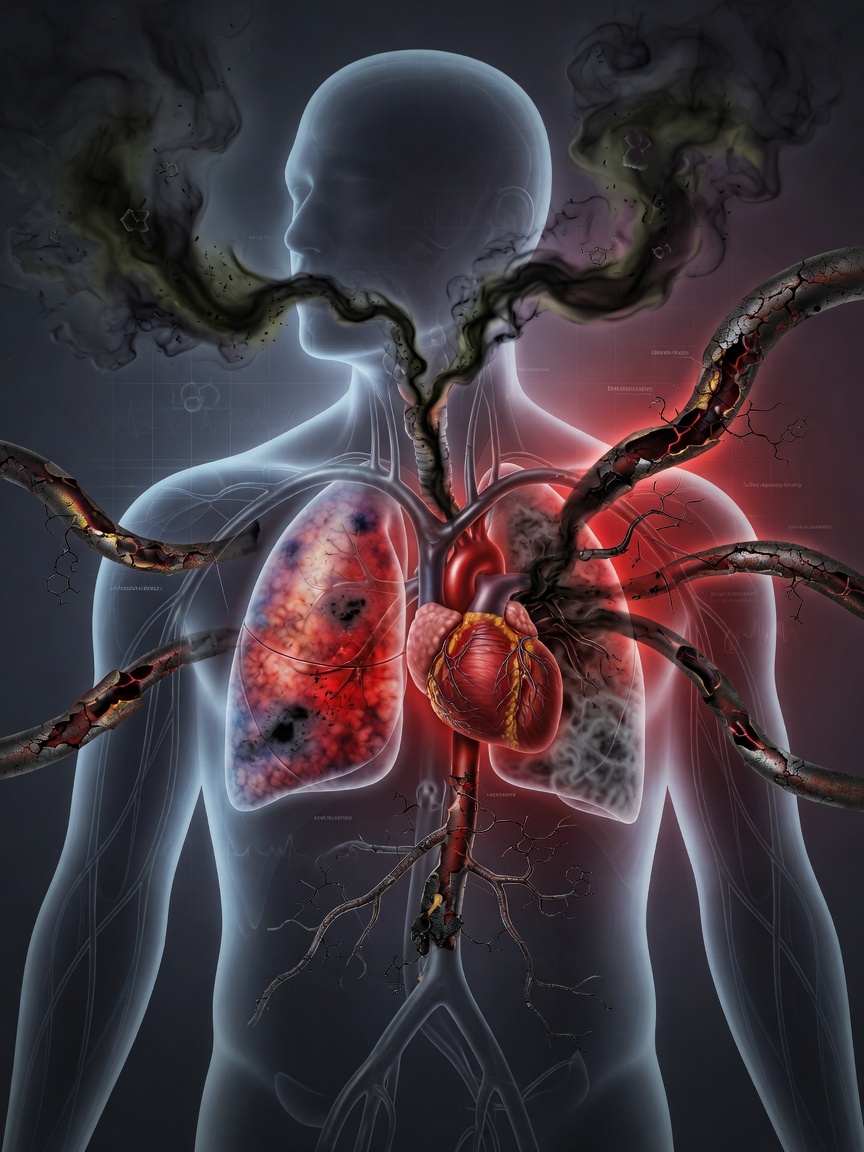
Many people think tobacco "mainly harms the lungs." A more accurate statement is: the lungs are the entry point, but **the blood vessels, heart, and immune system are battlefields simultaneously affected**. The nicotine, carbon monoxide, oxidative substances, and particulate matter in a single puff of smoke stimulate the airways while rapidly entering the bloodstream, making blood pressure harder to control, blood clots easier to form, infections harder to fight, and wounds slower to heal.
1. Why Is Smoking a "Systemic Disease"?
The damage from smoking can be understood on three levels:
1. **Local irritation**: The nasal cavity, throat, and tracheobronchial tree are repeatedly "abraded" by smoke, damaging cilia, increasing mucus, and sensitizing the airways.
2. **Rapid blood entry**: Many components cross the alveolar air-blood barrier into the bloodstream, affecting the brain, coronary arteries, and systemic blood vessels within seconds to tens of seconds.
3. **Chronic accumulation**: Endothelial damage, atherosclerosis, chronic inflammation, and immune dysfunction are "compounded" year after year.
This is why you often see a common combination: long-term smokers are more likely to experience **elevated or unstable blood pressure, chest tightness, angina or even heart attack, recurrent colds or pneumonia, and slow healing after surgery or injury** — these are not four unrelated pieces of bad luck, but manifestations of the same damage chain across different systems.
2. Overview of Damage: From "Inhalation" to "Heart, Lungs, and Immunity All Affected"
[1] Inhalation of tobacco smoke (gases + particulate matter)
        │
        ├─► Upper airway / bronchi: cilia↓, mucus↑, inflammation↑
        │
        ▼
[2] Alveolar exchange + partial mucosal absorption
        │
        ▼
[3] Into the blood: nicotine, CO, oxidative products, inflammatory mediator effects spread
        │
        ├─► Vascular endothelial damage / vasodilation↓
        ├─► Sympathetic excitation: heart rate↑, vasoconstriction, blood pressure↑
        ├─► Carbon monoxide occupies hemoglobin: oxygen-carrying capacity↓
        ├─► Platelets more easily activated: thrombotic tendency↑
        └─► Immune cell dysfunction + chronic low-grade inflammation
        │
        ▼
[4] Clinical consequences (examples)
   · Cardiovascular: hypertension difficult to control, angina, heart attack, stroke risk↑
   · Lungs: chronic bronchitis/COPD pathway, gas exchange↓, more prone to pneumonia
   · Immunity and repair: anti-infection ability↓, slow wound healing
The following sections break it down by system and specifically answer the four most frequently asked "why" questions.
3. Cardiovascular System: The Inner Wall of the Pipe Fails First, Then the Pump and Filter Follow
3.1 Vascular Endothelium: The Protective Coating Gets Scratched
The innermost layer of blood vessels — endothelial cells — acts like a protective coating on the inner wall of a pipe, responsible for:
Oxidative free radicals in smoke, nicotine-related stress, and inflammation triggered by particulate matter impair endothelial function. After the endothelium becomes "stiff, irritated, and prone to inflammation":
3.2 Nicotine: Stepping on the Gas of the Cardiovascular System
Nicotine stimulates the sympathetic nervous system, with typical effects including:
For those who already have atherosclerosis or plaques, this means: **the heart muscle needs more oxygen, but the "water pipes" supplying oxygen may be narrower and more fragile**. When supply and demand become unbalanced, chest tightness and angina easily occur; plaque rupture combined with a hypercoagulable state is the classic script for myocardial infarction.
3.3 Carbon Monoxide: Oxygen Seats Occupied by a Fake Passenger
Carbon monoxide (CO) has a much higher affinity for hemoglobin than oxygen, essentially "forcibly taking seats" on red blood cells. The result is:
**Endothelial damage + sympathetic excitation + decreased oxygen-carrying capacity + thrombotic tendency** — these are the "four-piece set" of how smoking damages the cardiovascular system.
3.4 Blood Becomes "Easier to Clot"
Smoking-related oxidative stress and inflammation make platelets more easily activated, while also affecting the balance of fibrinolysis and coagulation. In simple terms: blood vessels are already more prone to damage and plaque formation, and the blood is "stickier" and more prone to clotting — **the risk of blockage rises**.
4. The Pulmonary System: Cleaning Crew Goes on Strike, Exchange Station Shrinks, Defenses Thin
4.1 Mucociliary Clearance System: The Sweeping Broom Is Broken
The healthy airway surface has cilia and a mucus layer responsible for sweeping dust, bacteria, and particulate matter toward the pharynx to be coughed out or swallowed. Smoking causes:
The result is: more phlegm, coughing, foreign body sensation; pathogens and harmful particles stay longer in the airways — **a breeding ground for infection and chronic inflammation**.
4.2 Small Airways and Alveoli: Tubes Narrow, Sponge Ruptures
Long-term exposure can lead toward chronic bronchitis and chronic obstructive pulmonary disease (COPD):
The lungs' own gas exchange capacity declines, compounding the cardiovascular system's "oxygen supply pressure."
4.3 Local Immunity: Door Security Is Dysfunctional
Alveolar macrophages and other cells that should engulf pathogens and particles can become dysfunctional under long-term smoke exposure: sometimes they over-release inflammatory mediators, and sometimes their bactericidal and clearance efficiency drops. Combined with ciliary clearance failure, the risk of **community-acquired pneumonia, post-influenza complications, and recurrent lower respiratory tract infections** is higher at the population level — not "bad luck," but defense fortifications stripped of their bricks.
5. Immunity and Tissue Repair: Systemic Inflammation Simmers on Low Heat, Yet Healing Lacks Building Materials
5.1 Immunity Is Not Simply "Weakened," But "Dysregulated"
Smoking's effect on immunity is more like turning the control knobs out of order:
Thus smokers sometimes appear "especially prone to inflammation and infection," other times "wounds drag on for a long time" — both are **dysregulation**, not a single broken switch.
5.2 Slow Wound Healing: Four Barriers — Oxygen, Blood, Building Materials, Infection
For skin or surgical wounds to heal, roughly the following is needed:
1. Moderate inflammation to initiate debridement;
2. Good microcirculation to deliver oxygen and nutrients;
3. Fibroblasts to synthesize collagen and other "building materials";
4. Prevention of excessive bacterial colonization and infection.
Smoking disrupts multiple lines:
| Factor | How Smoking Interferes | Result |
|---|---|---|
| Oxygen supply | CO occupies hemoglobin + impaired lung ventilation | Relative tissue hypoxia |
| Blood supply | Vasoconstriction, endothelial dysfunction, poor microcirculation | Inadequate marginal tissue perfusion |
| Building materials & regulation | Inflammatory dysregulation, collagen-related repair affected | Delayed granulation and scarring |
| Infection | Reduced local and systemic defense | More prone to infection, dehiscence, delayed healing |
Surgery, dental, and plastic surgery-related education repeatedly emphasizes smoking cessation precisely because **healing and complication risks** are perceptible and statistically measurable.
6. Four High-Frequency Questions: Explaining the "Why" Thoroughly
Why Are Smokers More Prone to Hypertension?
The short chain is:
**Nicotine etc. → sympathetic excitation, vasoconstriction, increased heart rate → short-term rise in cardiac output and peripheral resistance; long-term endothelial damage, arterial stiffness, decreased vascular compliance → harder to maintain normal blood pressure baseline and harder to stabilize with medication.**
Smoking is not the sole cause of hypertension, but it is a **removable pressor factor**. Those who already have hypertension and continue smoking are essentially taking medication while stepping on the gas.
Why Are Smokers More Prone to Myocardial Infarction?
The common script for heart attack: **coronary atherosclerotic plaque rupture + thrombus formation → blood flow interruption → myocardial necrosis**.
Smoking pushes multiple links simultaneously:
1. Accelerates atherosclerosis, more plaques and less stable plaques;
2. Poor endothelial function, impaired vascular regulation;
3. Platelet activation, hypercoagulable tendency;
4. CO and decreased oxygen supply, increased heart rate, heart muscle more "hungry for oxygen";
5. Blood pressure and heart rate fluctuations increase plaque and oxygen supply-demand instability.
Therefore, in population studies and clinical observation, smoking has long been associated with increased coronary heart disease and heart attack risk — **"I'm young and haven't reached that age" is not a safe deposit box**; it only means the average onset may be later or more insidious, but the mechanisms have long been running.
Why Are Smokers More Prone to Pneumonia?
Imagine the lungs as a city:
Pathogens more easily remain, colonize, and descend into the alveoli; post-infection inflammation is more intense and recovery slower. Combined with systemic immune dysregulation, it becomes easier to slide from a "common cold/bronchitis" to **pneumonia or more severe lower respiratory tract infection**. For those with existing COPD, asthma, or heart failure, the risk superposition is even more pronounced.
Why Do Wounds Heal More Slowly?
Remember the four-character formula: **Hypoxia, Ischemia, Dysregulation, Susceptibility**.
Even tooth extraction, minor surgery, or diabetic foot ulcers — smoking can lengthen the timeline and increase complication probability. Those planning surgery are often required to quit smoking beforehand, not to scare you, but to free up oxygen and blood flow for tissue repair.
7. Cross-System Single Chain: One Puff of Smoke, Four Bad Outcomes
Summarizing into a single story line:
One puff of smoke
  → Airways irritated, cilia become lazy (laying groundwork for pneumonia)
  → Nicotine speeds up heart rate, transient vasoconstriction (blood pressure fluctuation)
  → CO steals oxygen-carrying seats (both heart muscle and wounds become hypoxic)
  → Oxidative stress damages endothelium, promotes inflammation (arteriosclerosis and plaques)
  → Platelets become more "excitable" (thrombosis / heart attack risk)
  → Immune regulation disordered (infection hard to clear, healing slows)
Thus: **hypertension, heart attack, pneumonia, slow healing** can be different "sub-shots" of the same lifestyle risk across different organs.
8. Clarifying Common Misconceptions
**"I only harm my lungs; my heart is fine."**
Nicotine and various components rapidly enter the bloodstream; the endothelium and coagulation system are fully engaged. The lung is the entry, but the cardiovascular and cerebrovascular systems are high-frequency targets.
**"I'm still young / I've smoked for decades and nothing has happened."**
Damage is mostly cumulative and silent. Atherosclerosis and declining lung function can progress far before symptoms appear; "nothing has happened yet" does not mean "nothing is happening."
**"I use a filter / I buy expensive cigarettes, so I'm safe."**
Filters and marketing cannot eliminate nicotine addiction, CO, or the core problem oflarge amounts of harmful gases and particles. There is no such thing as "safe combustible tobacco."
**"I only smoke occasionally, socially — that's fine."**
A single exposure can cause transient changes in endothelial function, blood pressure, and heart rate; lower frequency means relatively lower risk, but **it is not zero**, and it is easy to slide from "occasional" back to regular use.
**"I can still exercise, so my heart and lungs must be fine."**
Compensatory ability can mask early pathology. Shortness of breath, difficulty climbing stairs, morning cough and phlegm, hard-to-control blood pressure, slow healing — all are signals worth heeding, not things to wait for until "you're bedridden to count as sick."
**"Secondhand smoke has nothing to do with me."**
Family members sharing the same space also inhale sidestream and residual smoke; children and pregnant women are especially vulnerable. Quitting smoking is also protection for the shared living space.
9. Giving Hope: Quitting Is Not "Already Too Late"
Science communication needs honesty, but also hope:
Individual differences are large: age, smoking history, underlying diseases, exercise, blood pressure, blood lipids, and blood sugar all affect the trajectory. **The earlier you stop, the larger the repair window left for blood vessels, lungs, and immunity** — this statement is more useful than any scare tactic.
Practical action steps:
1. Treat smoking as a core risk factor for cardiovascular and lung health, not just a "bad habit";
2. If you already have hypertension, diabetes, coronary heart disease, or COPD, incorporate smoking cessation into your treatment plan;
3. If you experience chest pain or tightness, hemoptysis, progressive shortness of breath, recurrent pneumonia, or long-term non-healing wounds, seek medical attention promptly — do not self-attribute;
4. If you need help quitting, seek professional medical institutions' smoking cessation clinics or guideline-recommended interventions (behavioral support ± medications, etc.). This article does not promote any specific product.
10. Summary
| System | Core Damage | What You May Feel | Corresponding High-Frequency Outcomes |
|---|---|---|---|
| Cardiovascular | Endothelial damage, accelerated arteriosclerosis, sympathetic excitation, CO hypoxia, hypercoagulability | High/flucuating blood pressure, palpitations, chest tightness | Hypertension hard to control, angina/heart attack, stroke risk↑ |
| Lungs | Ciliary failure, chronic inflammation, alveolar destruction, reduced local defense | Cough, phlegm, shortness of breath, easily catch colds descending | Chronic bronchitis/COPD pathway, pneumonia and recurrent infections |
| Immunity & Repair | Immune dysregulation, chronic inflammation, poor microcirculation and oxygen supply | Infections drag on, post-surgery slow | Slow wound healing, complications↑ |
Smoking's assault on the body: **the entry is the respiratory tract, the battlefield is the whole body**. Understanding the mechanisms is not about inducing anxiety, but about turning "quit smoking" from an abstract moral imperative into a concrete decision to protect your heart, lungs, and healing ability.
**Disclaimer:** This article is a health science education piece intended to help readers understand the common mechanisms and risk logic of smoking-related damage. It cannot replace a licensed physician's in-person consultation, examination, or diagnostic advice. Issues such as abnormal blood pressure, chest pain, difficulty breathing, recurrent infections, or non-healing wounds should be evaluated promptly at professional medical institutions. The mechanisms described are educational-level generalizations; individual differences exist. This article does not constitute any product efficacy claim.